Ngorongoro Crater, Tanzania / April 2012
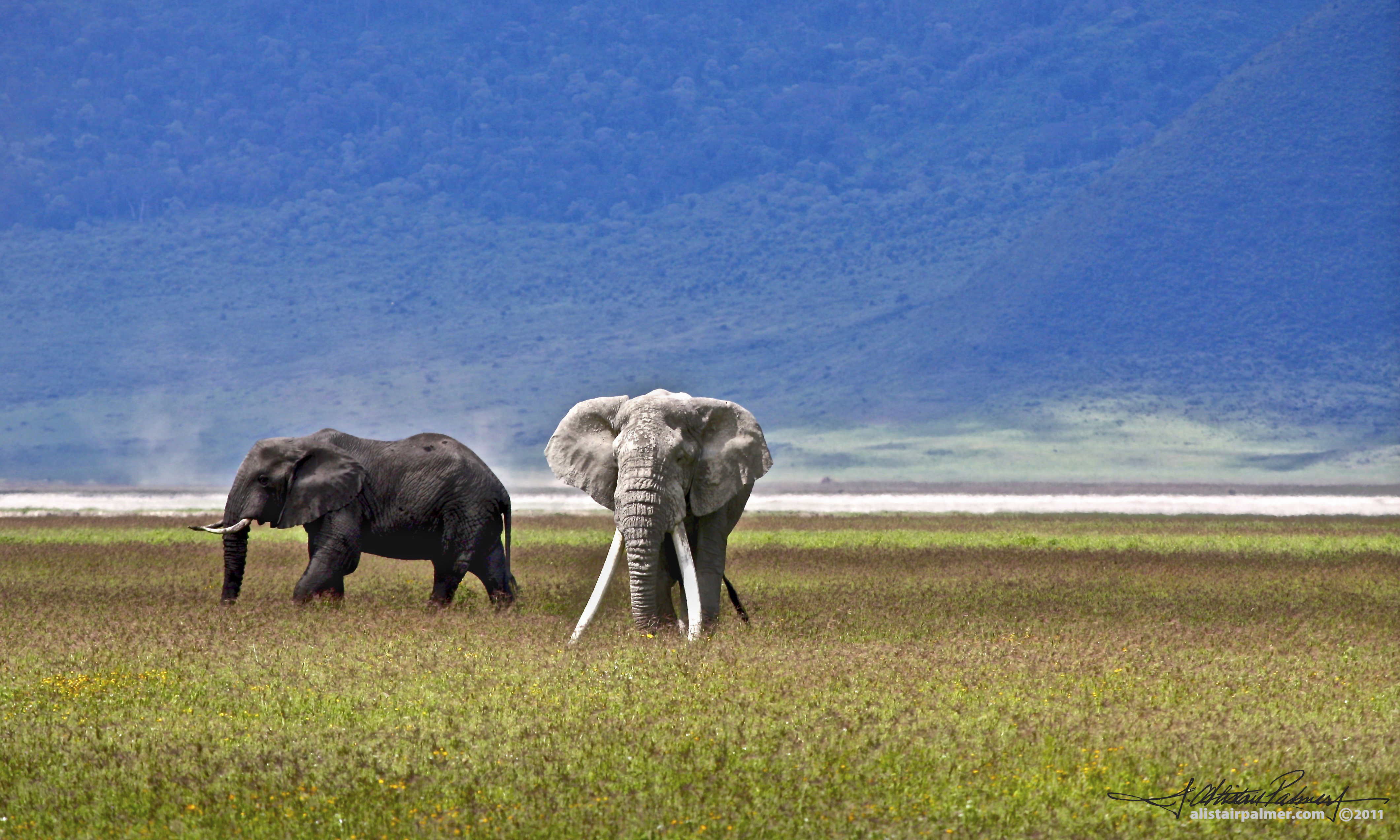
This was taken when I was on safari inside the Ngorongoro Crater. If you can believe it, the backdrop to these elephants is the crater wall. They are on the plains inside the crater. And how big is it inside? It’s about 16 miles in diameter. This is a UNESCO World Heritage Site (designated so in 1979) and is about 110 miles west of Arusha, a city near Mount Kilimanjaro.
The crater itself is a massive volcanic caldera. It was formed when it exploded and collapsed upon itself 2 to 3 million years ago. It’s about 610 metres or 2,000 feet deep and its floor covers 260 square kilometers or 100 square miles. It’s also considered one of the world’s most unchanged wildlife sanctuaries. Why? Because many of the animals that live inside, stay inside and are therefor isolated from integrating with their same species outside.
Nearby is the Oldupai Gorge. This is where Mary and Louis Leakey discovered Lucy (Australopithecus), the oldest known human remains and key to understanding our earliest human evolution.
I also call this elephant the great white. I would have a hard time believing its still alive today. Compare those ivory tusks to that of the dark elephant! The tusks were so massive that it appeared he was pushing them along the ground instead of having to lift them. Imagine the weight and how that must take a lot of extra strength to just walk a distance. Strong neck muscles, ya think? I managed to get some very telling close ups of it, that I may share another day.
Some good news… I just read an article entitled: “Beijing Intends To Shut Down Ivory Trade By End Of 2017” and all this is “designed to curb the mass slaughter of African elephants.” The Chinese government will phase out the processing and selling of ivory products. It’s been declared a ‘game changer’ for Africa’s elephants by the New York based Wildlife Conservation Society. So there’s hope to save these magnificent animals.
Just being inside the crater is an incredible experience and strange vibe. I’ve had the good fortune to have been there once before when I was about 26 and again at about 58. Both times were special and the mystique of being ‘inside’ a volcano that exploded like it did, is hard to describe. Far more powerful than the 1980 eruption of Mt. St. Helen’s in Washington state and likely far more spectacular! And that’s saying a lot because that explosion wreaked havoc with its dust reaching as far away eastern United States and parts of Europe.
Comments